Eye of Ra vs Eye of Horus – Understanding The Difference Now!
The Eye of Ra – Symbol of Power, Protection, and Divine Wrath
The Eye of Ra stands as one of ancient Egypt’s most powerful emblems, embodying the authority and fierce energy of the sun god. Unlike the Eye of Horus, which is linked to healing and renewal, the Eye of Ra represents dominance, defense, and retribution.
For anyone exploring Egypt’s temples or deciphering hieroglyphs, understanding this symbol provides a deeper connection to the myths that shaped pharaonic culture.
In mythology, the Eye of Ra is not separate from Ra himself but an extension of his divine power. Depicted as a human eye with solar motifs, it symbolizes his eternal vigilance over creation and his ability to unleash devastation when needed. Legends even describe Ra sending his eye—sometimes personified as the lioness goddess Sekhmet—to punish rebellious humanity, showing its role as both protector and destroyer.
The Eye of Ra is also deeply tied to the sun’s dual nature. It represents light and creation but also fire, drought, and chaos. Temple carvings at Karnak and Abu Simbel show this duality, often portraying the eye beside Ra’s solar boat as it sails across the sky.
Modern interpretations sometimes confuse it with the Eye of Horus, but the distinction is clear: Horus’s eye heals and safeguards, while Ra’s eye commands and conquers.
On guided tours, experts often highlight these differences, pointing out artifacts like amulets and tomb paintings where the symbols appear side by side. Whether marveling at Sekhmet’s rampage in myth or spotting the Eye of Ra carved into temple walls, travelers encounter a symbol that embodies Egypt’s awe of the sun’s life-giving yet destructive force.
Who Was Ra? The Sun God Behind the Symbol
Ra was ancient Egypt’s supreme solar deity, seen as both creator of life and upholder of cosmic balance. His presence dominates temples, tombs, and artifacts across the Nile, making him one of the most important figures for travelers seeking to understand Egypt’s spiritual heritage.
He is often shown with a sun disk crown, sailing the skies each day in his solar barque, bringing light to the world. The Eye of Ra, inseparably linked to him, symbolizes his ability to nurture but also to punish.
The ankh (symbol of life) frequently appears alongside the Eye of Ra, together representing vitality paired with divine authority. Travelers can spot this combination in temple carvings at Heliopolis—Ra’s cult center—or in jewelry on display at Cairo’s Egyptian Museum.
Guides often explain how pharaohs adopted the Eye of Ra, wearing it with the ankh on crowns to affirm their divine right to rule. Understanding Ra’s identity allows visitors to see temples like Karnak or Abu Simbel not simply as ruins, but as living tributes to light, creation, and divine power.
Origins and Spiritual Significance of the Eye of Ra
According to creation myths, the Eye of Ra emerged as a force of cosmic power. One legend tells of Ra sending his eye to search for his children; when it returned, his tears created humanity. This tale shows the eye’s duality: it is both life-giving and destructive.
The symbol was often personified as goddesses such as Hathor and Sekhmet, who channeled Ra’s protective wrath to preserve ma’at—cosmic order. In tombs, amulets featuring the Eye of Ra paired with the ankh were used to invoke balance, protection, and divine authority.
In rituals, priests invoked the eye during temple ceremonies to honor Ra’s daily solar journey. Pharaohs also claimed its power as a sign of their unyielding rule. Today, travelers can still see the symbol carved on obelisks, temple walls, and solar sanctuaries across Luxor, linking modern visitors directly to ancient spiritual practices.
Myths and Legends Surrounding the Eye of Ra
The Eye of Ra is more than an image; it is a central figure in Egypt’s mythology of power and cosmic order.
Some myths distinguish between Ra’s right and left eyes—the right symbolizing the sun, the left the moon. At times, Hathor embodied the left eye, bringing nurture, while Sekhmet took the right, unleashing divine fury.
Another legend explains that Ra set his eye in the sky as the sun, so it could eternally watch over the earth by day and battle chaos by night.
Travelers exploring Karnak Temple or sailing the Nile will encounter countless carvings of Ra’s eye, reminders of its role as both guardian and avenger. Amulets bearing its image were worn for protection, while priests invoked it in rituals to preserve balance.
The Spiritual Role of the Eye of Ra
The Eye of Ra served as a bridge between divine authority and human devotion. Egyptians carried charms crafted from gold or faience to harness the sun’s energy and ward off chaos.
Hieroglyphs of the eye—depicted as a human eye with teardrop markings and solar disks—appear in tombs throughout the Valley of the Kings, representing Ra’s eternal watch over the dead.
Priests used the symbol to sanctify spaces, while pharaohs adorned their crowns with it as proof of divine legitimacy. Today, travelers can see these carvings at Medinet Habu Temple in Luxor or purchase modern versions in Cairo’s Khan El Khalili market.
What Power Did the Eye of Ra Hold?
The Eye of Ra represented unmatched authority—creation through light and destruction through fire. While Horus’s eye heals and protects, Ra’s eye wields dominance, embodying his dual role as life-giver and enforcer of order.
When Ra merged with Amun, forming Amun-Ra, the symbol became even more potent, appearing in Luxor’s temples as a sign of omnipotence.
Depending on Ra’s will, the eye could manifest as Hathor, a gentle protector, or Sekhmet, a fierce avenger. This versatility made it a powerful tool in myths, politics, and daily devotion.
The Eye of Horus – Healing, Protection, and Wisdom
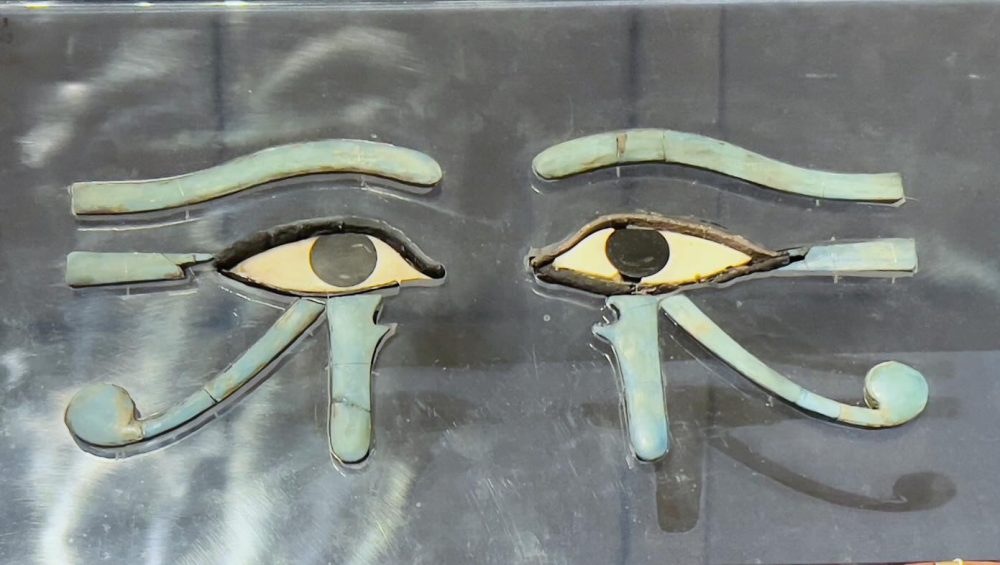
In contrast, the Eye of Horus (or wedjat) symbolizes healing, restoration, and protection. Shaped like a stylized falcon’s eye, it reflects the myth where Horus’s eye was torn out during battle with Set and later restored by Thoth. Its design even encoded mathematical fractions, linking it to wholeness and balance.
Used as a talisman, the Eye of Horus was painted on coffins, worn as jewelry, and carved into temple walls, especially at Edfu Temple. It promised safety in life and the afterlife.
Travelers today can find Eye of Horus amulets in markets and see its carvings in temples, where it continues to symbolize resilience, wisdom, and divine guardianship.
Eye of Ra vs Eye of Horus – The Key Differences
- Symbolism: Horus’s eye brings healing, balance, and protection; Ra’s eye embodies raw power, punishment, and authority.
- Mythology: The Eye of Horus is tied to Horus’s battle with Set; the Eye of Ra comes from Ra’s cosmic role and is often personified by goddesses like Sekhmet.
- Appearance: The Eye of Horus resembles a falcon’s eye with stylized markings; the Eye of Ra is typically shown as the right human eye with solar or fiery motifs.
- Direction: Horus’s eye is often depicted as the left eye (moon); Ra’s eye as the right eye (sun).
- Function: Horus’s symbol protected individuals and sailors; Ra’s symbol punished enemies and upheld pharaonic rule.
Both are still widely used today in jewelry, tattoos, and spiritual practices. For travelers, spotting them in temples or bazaars adds a personal dimension to Egypt’s living history.
Conclusion – Which Eye Speaks to You?
The Eye of Ra and the Eye of Horus are more than ancient images—they are two perspectives on Egypt’s worldview. Ra’s eye reflects authority, fire, and divine wrath, while Horus’s eye embodies healing, renewal, and protection.
As you explore Egypt, you’ll encounter both: the Eye of Horus on boats or amulets as a talisman of safety, and the Eye of Ra carved into sun temples as a reminder of cosmic power.
Whichever symbol resonates with you, each offers a timeless connection to Egypt’s spiritual heart—an echo of a civilization that saw the world through eyes of both fury and grace.